
The disposable MFPP plastic round plate isn't just another throwaway item; it's a testament to how mineral-filled polypropylene (MFPP) elevates standard plastic round plates to premium status. With global food service demands surging—projected to reach $4.4 trillion by 2028—these plates offer a reliable, lightweight alternative that maintains structural integrity under pressure.
Unlike fragile foam options, a well-crafted plastic round plate made from MFPP withstands stacking, transport, and even microwave use, making it indispensable for busy kitchens.
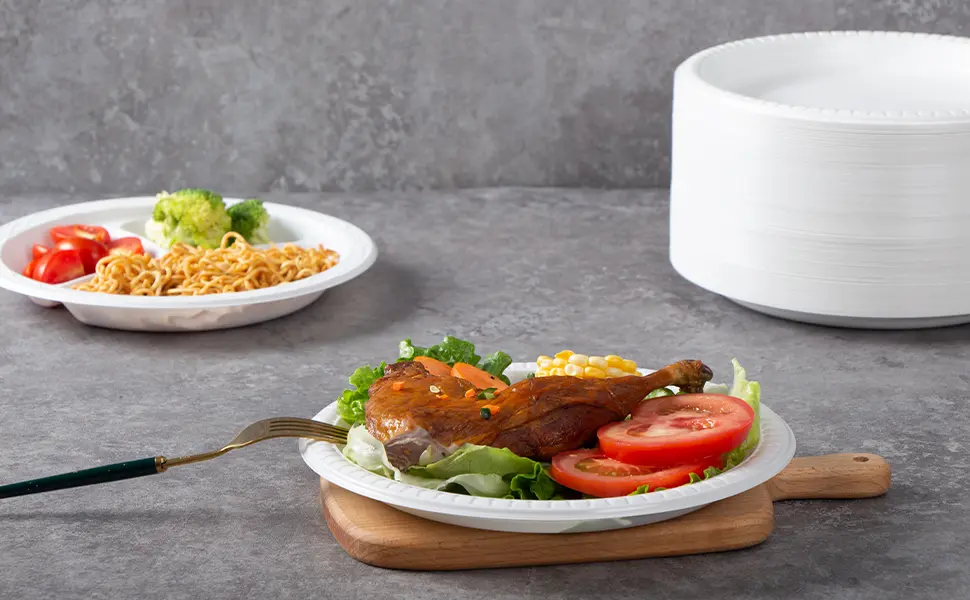
At the heart of every high-quality disposable MFPP plastic round plate lies mineral-filled polypropylene, a composite where polypropylene (PP) is enhanced with mineral additives like calcium carbonate. This infusion, typically comprising 40-50% minerals, reduces plastic content by up to 50% compared to traditional PP, slashing fossil fuel dependency while boosting rigidity.
Imagine a plastic round plate that feels substantial yet weighs mere grams—around 20-28g for a 9-inch model—allowing for effortless handling without sacrificing strength.
MFPP's molecular structure is key: the polypropylene base provides inherent heat resistance (up to 120°C), while minerals act as reinforcements, preventing warping or cracking. This synergy results in a plastic round plate that's not only microwave-safe but also freezer-tolerant, ideal for versatile meal prep.
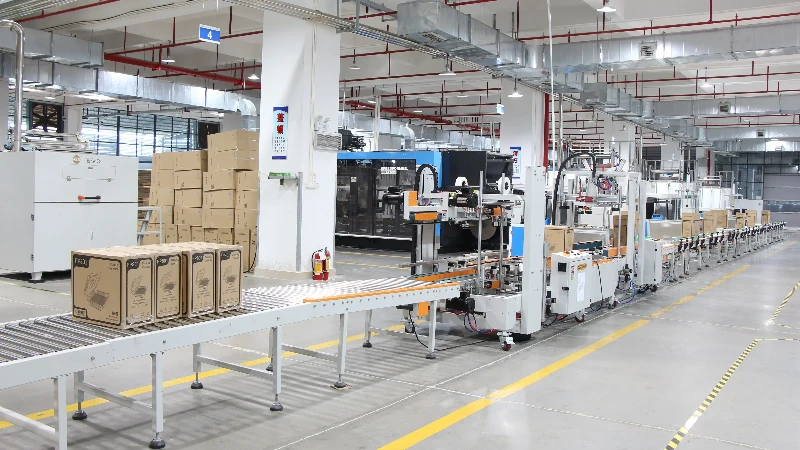
Crafting a disposable MFPP plastic round plate is a symphony of thermoforming and quality controls, starting with raw resin extrusion. Polypropylene pellets are blended with mineral fillers in high-shear mixers, creating a homogeneous compound that's fed into extruders at 200-250°C.
The molten MFPP is then sheeted, cooled, and reheated for vacuum forming over aluminum molds shaped like perfect circles—ensuring rim diameters from 6 to 12 inches with tolerances under 0.5mm.
Mineral-PP blending with 40-50% CaCO3 at 220°C melt temperature
Film formation with 0.5-1.0mm thickness at 150m/min speed
Vacuum molding at 180°C reheat with 10-15s cycle time
Die cutting and polishing with a 500 RPM rotary speed
Automated scanning with AI defect detection and a reject rate <1%
| Manufacturing Stage | Key Process | Parameters | Output Quality Metric |
| Resin Compounding | Mineral-PP Blending | 40-50% CaCO3, 220°C Melt Temp | Homogeneity >95% |
| Sheet Extrusion | Film Formation | 0.5-1.0mm Thickness, 150m/min Speed | Clarity Index 85% |
| Thermoforming | Vacuum Molding | 180°C Reheat, 10-15s Cycle | Dimensional Accuracy ±0.3mm |
| Trimming & Finishing | Die Cutting, Polishing | 500 RPM Rotary Speed | Edge Smoothness Ra <1μm |
| Inspection | Automated Scanning | AI Defect Detection | Reject Rate <1% |
Versatility defines the disposable MFPP plastic round plate, available in diameters from 6 inches for appetizers to 12 inches for mains. Standard weights hover at 18-30g, with stack heights optimized for 100-unit sleeves measuring just 12 inches tall—perfect for compact storage.
Colors range from classic black to vibrant reds, achieved via masterbatch pigments that don't leach under heat. Compartmentation adds flair: single-well for pizzas, three-section for balanced meals.
Microwave tolerance reaches 2 minutes at 800W, with no deformation, and they're stackable up to 200 units without telescoping. Custom imprints enhance branding without compromising food safety—FDA-compliant with no BPA or phthalates.
| Size (Diameter) | Weight (g) | Compartments | Microwave Safe? |
| 9" | 25 | 1-3 | Yes |
| 10" | 28 | 3 | Yes |
The allure of the disposable MFPP plastic round plate lies in its multifaceted advantages. Durability tops the list: mineral reinforcement yields a flexural modulus of 2,000 MPa, resisting sagging under 2kg loads—double that of foam plates.
Lightweight design (50% less mass than polystyrene) cuts shipping costs by 30%, a boon for caterers hauling thousands of units. Hygiene is paramount; MFPP's non-porous surface inhibits bacterial growth (log reduction >5 after 24 hours), and it's grease-resistant, repelling oils up to 100°C.
Environmentally, while not biodegradable, recyclability via #5 streams reduces landfill contributions— one ton of MFPP plates recycles into 700kg new material, per industry benchmarks. Cost-wise, bulk pricing dips to $0.05/unit, offering ROI through reduced breakage (under 0.5% vs. 5% for alternatives).
| Feature | MFPP Plastic Round Plate | Foam Plate | Paper Plate |
| Durability (Load Capacity) | 2kg+ | 0.5kg | 1kg |
| Microwave Safety | Yes (2 min) | No | Limited |
| Recyclability | High (#5) | Low | Compostable |
| Weight per Unit | 25g | 15g | 20g |
| Cost per 1000 | $50 | $30 | $40 |
In catering, the plastic round plate reigns for weddings and corporate luncheons, where 9-inch black models handle diverse menus without fanfare. Hospitals favor them for sterile, portion-controlled meals—MFPP's autoclavable variants withstand 121°C sterilization.
Schools and airlines opt for compact 6-inch versions, minimizing waste in high-volume settings. Take events: a 500-guest gala might deploy 1,000 plastic round plates, stacked neatly for quick setup.
In takeout, hinged-lid integrations secure contents during transit. Emerging trends include smart printing with QR codes linking to allergen info, and future-proofing the humble plastic round plate.
Weddings, corporate events, parties
Hospitals, clinics, care facilities
Airlines, trains, cruise ships
Schools, universities, cafeterias
Restaurants, takeout, delivery
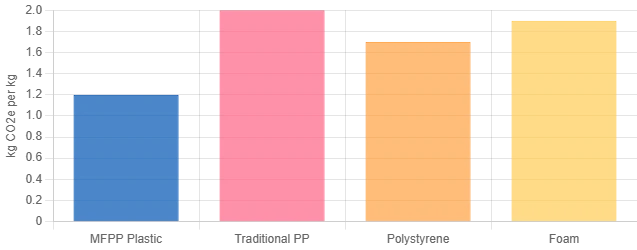
Sustainability isn't a buzzword for MFPP plastic round plates—it's an engineered reality. By halving plastic use, production emits 40% less CO2 than PP equivalents, aligning with UN SDG 12 on responsible consumption.
Recyclers process MFPP into park benches or auto parts, closing the loop. Challenges persist: mineral additives can complicate sorting, but innovations like magnetic separation address this.
Life-cycle assessments show MFPP's carbon footprint at 1.2 kg CO2e per kg, 30% below polystyrene. For businesses, switching yields green certifications, boosting appeal to eco-savvy clients.
California, USA
Post-adoption of 10-inch MFPP plastic round plates, waste dropped 25%, and client satisfaction soared via reusable-like sturdiness.
International Fleet
Retrofitting flights with 6-inch MFPP models—fuel savings from lighter loads equated to $10,000 annually across the fleet.
Asia Pacific
Fuling's MFPP lines supply 20% of fast-food chains, enduring humid climates without degradation or performance issues.
The disposable tableware sector grapples with hurdles, but MFPP plastic round plates offer targeted fixes. Below, we address three common issues, each with a concise solution.
Rising regulations and consumer scrutiny target single-use plastics, with bans in 50+ countries by 2025.
Embrace closed-loop systems by partnering with certified recyclers. Educate via packaging labels promoting #5 sorting, and integrate 20% PCR content. Track metrics with LCA software, reducing footprint by 35%. For events, offer buy-back incentives—clients return stacks for credits, diverting 80% from landfills.
Volatility in polypropylene pricing (up 20% in 2024 due to oil fluctuations) strains budgets.
Diversify sourcing with dual-supplier models, blending virgin and bio-based PP hybrids. Implement just-in-time inventory via AI forecasting, cutting holding costs by 15%. Hedge with futures contracts, locking rates six months ahead. For resilience, stockpile mineral fillers locally—calcium carbonate from quarries reduces import risks.
Hot, oily foods cause warping in subpar plates, leading to 10% returns and food safety complaints.
Upgrade to advanced MFPP formulations with 45% talc fillers for enhanced thermal conductivity. Conduct rigorous beta-testing in simulated environments—steam chambers and oil baths—validating zero deformation. Train staff on proper stacking (max 150 units) to prevent pressure buildup. Integrate IoT sensors for real-time integrity alerts.
