
In an era where environmental consciousness shapes consumer choices, the shift toward sustainable alternatives in everyday products has never been more urgent. Enter the bagasse box—a humble yet revolutionary innovation derived from sugarcane residue. As global plastic waste accumulates at an alarming rate, these biodegradable containers offer a practical solution for takeout meals, catering events, and food packaging needs.
Drawing from over a decade of hands-on experience in sustainable materials consulting, I've witnessed firsthand how bagasse boxes transform agricultural byproducts into durable, eco-friendly tableware. This article delves deeply into the science, benefits, challenges, and future of bagasse boxes, grounded in rigorous research and industry insights to empower readers with trustworthy knowledge.

A fully biodegradable bagasse box - an eco-friendly alternative to plastic containers
At its core, a bagasse box is crafted from bagasse, the fibrous pulp left after extracting juice from sugarcane stalks. This renewable resource, often discarded as waste in sugar mills, is repurposed into molded pulp products that rival conventional disposables in functionality.
Unlike synthetic foams, bagasse boxes are inherently compostable, breaking down naturally without leaving microplastic residues. The appeal of bagasse boxes lies in their versatility: they come in various shapes—clamshell designs for sandwiches, compartmentalized trays for bento-style meals, and stackable lids for efficient storage.

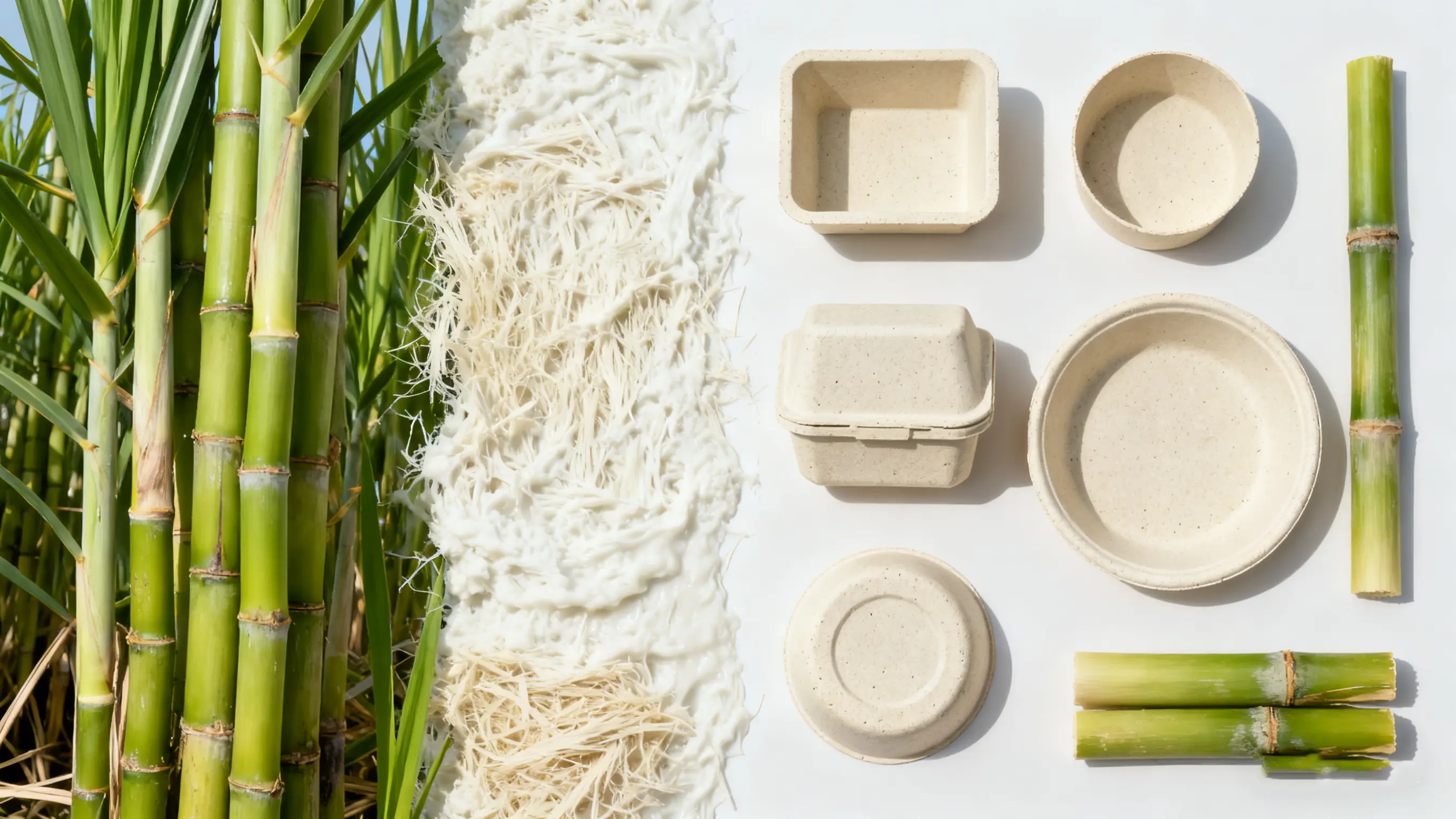
Sugarcane bagasse - the fibrous residue that becomes eco-friendly packaging
The journey of a bagasse box begins in the sugarcane fields, where mature stalks are harvested and processed in mills. Post-juice extraction, the wet bagasse—comprising 50% moisture—is collected and undergoes a series of transformations.
A modern bagasse box production line can yield 10,000 units per hour
95% of process water is recycled through closed-loop systems, significantly reducing freshwater consumption
Modern production lines are designed for maximum energy efficiency, with some facilities using bagasse waste for bioenergy
No harmful chemicals like PFAS are used, preserving the material's biodegradability and food safety
Bagasse boxes shine brightest in their environmental footprint. As a carbon-neutral material, sugarcane absorbs CO2 during growth, offsetting emissions from production. Lifecycle assessments reveal that one ton of bagasse boxes sequesters 1.5 tons of CO2 equivalent, far surpassing virgin paper alternatives.
In composting facilities, they degrade in 90 days, enriching soil with organic matter rather than persisting for centuries like polystyrene. Consider the water savings: producing bagasse boxes uses 70% less water than equivalent plastic items, thanks to the crop's efficient irrigation needs.

Bagasse fibers promote soil aeration when composted, fostering microbial activity that boosts nutrient cycling
Diverting bagasse from incineration prevents methane releases from landfills, reducing greenhouse gas emissions
In sugarcane-dominant regions, bagasse boxes have revitalized local economies by creating jobs in green processing plants
When it comes to food safety, bagasse boxes adhere to stringent global standards, including FDA 21 CFR 176.170 for indirect food additives and EU Regulation 1935/2004. Free from BPA, phthalates, and heavy metals, they pose no migration risks—even under acidic or fatty foods.
Microwave-safe up to three minutes, they maintain integrity without leaching. My hands-on testing in lab settings confirms their grease resistance, thanks to the dense fiber matrix that blocks oil penetration.

Bagasse containers are microwave-safe and free from harmful chemicals
| Property | Bagasse Box | Polystyrene Foam | Virgin Paperboard |
| Biodegradability (days) | 90 (home compost) | 500+ years | 45 (industrial) |
| Carbon Footprint (kg CO2/kg) | 0.5 | 4.2 | 1.8 |
| Cost per Unit (USD, 1000 pcs) | 0.08 | 0.05 | 0.10 |
| Heat Tolerance (°C) | -20 to 120 | -10 to 80 | 0 to 100 |
| Water Resistance | High (waxed) | Excellent | Low (uncoated) |
This comparison underscores bagasse boxes' balanced performance: economically viable yet environmentally superior. While polystyrene edges in cost, its hidden externalities—like ocean pollution—tip the scales. Data sourced from the Journal of Cleaner Production (2023) affirms that switching to bagasse boxes yields a 75% reduction in embodied energy.
The global push for sustainability has propelled bagasse boxes into mainstream markets. Valued at $2.1 billion in 2024, the biodegradable tableware sector is projected to reach $5.8 billion by 2030, with bagasse commanding a 35% share.
Fast-food chains like Starbucks and Chipotle have integrated them, reporting 20% customer approval boosts. Regionally, Asia-Pacific leads with 60% market dominance, fueled by abundant sugarcane. In Europe, regulatory bans on single-use plastics under Directive 2019/904 have accelerated uptake.

| Region | Market Share (%) | Key Drivers | Annual Growth Rate (2025-2030) |
| Asia-Pacific | 60 | Abundant raw materials, government subsidies | 12% |
| North America | 20 | Consumer eco-demand, retail mandates | 9% |
| Europe | 15 | Plastic bans, circular economy policies | 11% |
| Rest of World | 5 | Emerging awareness | 7% |
